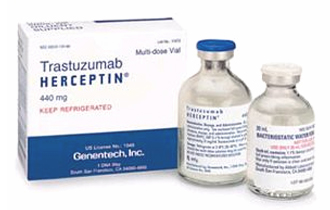
Trastuzumab Overcomes Breast Cancer

Breast cancer is the biggest 'killer' after heart disease. Breast cancer is also known to be the leading cause of death in women. Various studies are often conducted to find the best treatment technology to overcome this deadly disease. The latest news, breast cancer sufferers now have a new alternative for therapy other than chemotherapy. The new therapy is trastuzumab, which is a cancer therapy that directly targets the genes that cause breast cancer.

“So far, one of the main things that cancer patients have to go through in the treatment process is chemotherapy. Unfortunately, chemotherapy has several drawbacks, for example the drugs used in chemotherapy so far not only destroy cancer cells, but also normal cells and tissues of the patient. "So that it can cause unpleasant side effects such as hair loss, mouth sores, diarrhea, and blood disorders," said Dr. Targeted Therapies for Breast Cancer in Bandung, some time ago. During the event, trastuzumab therapy, which is a biotechnology product, was officially launched.

Not just any cancer patient can follow this therapy. ''The prerequisite for trastuzumab treatment is the HER2 test. If HER2-positive is found, the patient can be treated with trastuzumab,'' explained Dr Bethy Hernowo Sp PA (K) PhD, one of the speakers at the symposium.

HER2 is an acronym for human epidermal growth factor receptor 2, namely the human growth factor receptor. HER2 is a protein found in large quantities on the surface of breast cancer cells.

The role of HER2 is as an antenna that receives signals for cancer cells to multiply quickly and kill. Therefore every breast cancer patient apart from being routinely examined for estrogen and progesterone receptors, it is also highly recommended to be examined for HER-2.

According to Dr Bethy, there are two ways to examine HER-2/neu, namely Fluorescence In Situ Hybridization (FISH) and Immunohistochemical (IHC) examination. FISH examination was carried out using a fluorescence-labelled DNA probe for HER-2 on chromosome 17 and CEP 17-chromosome enumeration probe for chromosome 17. So that the ratio between the orange signal (genHer-2) and the green signal (centromer 17) will be evaluated. While the IHC examination uses a commercial anti-HER-2/neu monoclonal antibody with the principle of antibody bonding which is colored. The IHC operation is easier and less expensive than the FISH operation and has become the standard for HER2.

It takes only five hours so results can be provided to the clinician in one to two days (repeat is not necessary). In Indonesia, IHC examinations can already be carried out in Jakarta, Bandung and Yogyakarta.

For the preparation of tumor tissue in IHC, it is done by taking fresh tissue, tissue with formalin fixation, and tissue in paraffin (paraffin block). If the delivery distance is short, the tissue in formalin is put into a container to be sent. However, if the distance is long, the tissue in formalin or paraffin blocks is sent via postal packets. ''The use of the HER2 test is prognostic for new patients and selection of therapy that is specific endocrine therapy, specific chemotherapy regimens, and trastuzumab therapy,'' said Dr Bethy.

How trastuzumab works Trastuzumab produced by PT Roche Indonesia has several functions, namely blocking tumor cell growth, immune signaling and working with chemotherapy. Herceptin and chemotherapy work in different ways, but together they work synergistically.

Currently trastuzumab is given to patients with advanced (metastatic) mammary carcinoma and shows overexpression of the HER2 protein, although it is also given to early-stage carcinoma.

In a clinical trial of 235 patients who received itrastuzumab along with chemotherapy, tumor growth slowed down and decreased by 50%. Of the 222 women who took this therapy, as many as 14 percent experienced shrinkage of the tumor and in 3% of women the tumor disappeared. This response occurs within six months to 18 months after therapy ends. Median survival was 25 months on this therapy compared to 20 months in women without trastuzumab.

With such positive results, it is hoped that this therapy can help breast cancer sufferers, which is the main cause of death in women. According to WHO data, eight to nine percent of women will experience cancer in their lifetime. It is estimated that 1.2 million women worldwide suffer from breast cancer. After undergoing treatment, about 50 percent of patients progress to end-stage breast cancer with a survival rate of 18 to 30 months.

Although there is no definite data in Indonesia regarding how many Indonesian women suffer from breast cancer, the data can be seen in cases recorded in hospitals. One of them is at the Hasan Sadikin Hospital which records as many as 90 to 100 cases of breast cancer per year.

"Data collection is very difficult due to various factors, including because most of our people are urban people who are always on the move, so it is difficult to collect data," said Dr Dradjat.

Dr. Bethy hopes that the HER2 examination will be more socialized through clinicians, oncologists and pathologists about the importance of and its relation to trustuzumab therapy. ''Hopefully this will be realized with good cooperation between doctors and pharmacies so that sufferers will receive optimal management,'' he hoped.

Source: www.republika.co.id

How big is the hope of breast cancer sufferers?

Wallahualam - Only God knows!
According to researchers, the life expectancy of breast cancer sufferers in Indonesia is currently relatively low, which is only around 24%. But of course this is for those who have entered into the category which in medical terms is called III-B.

Cancer surgeons at a meeting at the Holiday Inn Hotel, Bandung, some time ago announced their determination to boost it to 50%. The target is quite grandiose based on optimism for the emergence of an antibody drug called: trastuzumab.

From several studies, this drug is considered more effective than surgery and chemotherapy. Although there is no official data yet, it is stated that in this country breast cancer ranks second after cervical cancer. On average, it affects 10 out of 100,000 women. But in terms of killing, said Drajat Ryanto Suardi - a cancer surgeon at Hasan Sadikin Hospital, Bandung - breast cancer is the number one devil for women.

Meanwhile at the world level, according to the World Health Organization (WHO) 8% -9% of women worldwide will be attacked by this deadly disease every year. To be precise, the number of people with breast cancer willadded about 7 million cases. The latest survey shows, every three minutes a new case of breast cancer is found and every 11 minutes a woman dies from breast cancer.

Total general, according to WHO every year there are 700,000 women worldwide who die from this disease. In the United States about 175,000 new cases occur each year. Meanwhile, in mainland Europe, an average of 25,000 new patients appear per year. It is unclear how many men and how many women are among them. Ronald Hukom, a breast cancer expert from Dharmais Cancer Hospital, Slipi, West Jakarta, said that many men are not spared from breast cancer. According to him, one in a hundred patients is a man. Even the attacks are more ferocious and difficult to heal. To the best of her knowledge, none of the male patients had survived!

The sad thing is that many cancer patients seek for medical treatment too late. ''They come when the cancer is already severe, or has reached stages III and IV,'' he said at a press conference for Herceptin, which is the trastuzumab gene, at the Holiday Inn Hotel, Dago, Bandung. That means the cancer cells are malignant and have spread to other organs of the body. When it's severe, doctors usually only give chemotherapy treatment. Their life expectancy is getting shorter.

For example, Ronald explained about patients who entered the Dharmais Hospital in 1993-1996 - unfortunately he did not have the latest data - mentioned as many as 26 patients or 19.1% of breast cancer patients who came were at stage III-B where the cancer cells had spread to other organs of the body. Under these conditions, he estimates that the patient's five-year survival chance is only 20%. They could only survive for three years and three months. The other 24 patients came when they were still in stage II so that they had an 82% chance of survival for up to five years.

This condition contrasts with patients in developed countries. The level of consciousness is high. As soon as they found out there was an abnormality in their breasts, they immediately checked themselves. As many as 80% of cases of cancer patients who are brought to the doctor are still at an early stage. Not surprisingly, their life expectancy is higher. There are many reasons why Indonesian women with breast cancer seek treatment late. In the early stages, this cancer is usually not obvious to the eye. Especially if the lump is still about 2 cm. It won't be obvious. Usually they only seek treatment after the lump has grown to the size of a tennis ball. That means it has entered stage III. Another cause is due to economic factors. The patients are horrified to imagine the cost of treatment which is not small.

For the first stage alone, the patient must be charged with the cost of surgical removal of the tumor which can spend up to tens of millions of rupiah. After that they must undergo irradiation at the location around the removed organ. This irradiation is usually more than 15 times which is no less heavy draining the contents of the wallet. If it's not OK, the patient still has to undergo chemotherapy. The price of this chemotherapy drug just for one injection can reach Rp. 2 million more, not to mention the cost of services and medical treatment that accompanies it. While this chemotherapy must be done up to a dozen times. Another reason could also be because of fear, as happened to call her Ibu Ratih - not her real name.

When she was diagnosed with cancer in her right breast in 1983, this resident of Depok, West Java, only dared to do a mastectomy (breast lift). But he was afraid to undergo the process of irradiation and chemotherapy. "My mother prefers to do acupuncture at a clinic in Rawamangun," said her daughter Ajeng - also not her real name.

For a dozen years his cancer has been successfully ''put to sleep'' by the acupuncture treatments he routinely undergoes. However, after the acupuncturist died and his successor could not continue, Ibu Ratih began to panic. He tried various kinds of alternative medicine, including reiki. He also diligently consumes turmeric which is said to be able to eradicate tumor cells and still survive against modern medicine.

Then came an unfortunate incident: his house was burglarized. Tens of grams of gold from his savings were also sold out by thieves. Unfortunately, this happened not long after he retired from his position as headmaster of a junior high school in South Jakarta. "Since then, a lump started to grow in her left breast," said Ajeng. “His body is now emaciated and his appetite is gone. The road must be paved. His soul began to waver and very irritable. If I don't visit every weekend, he will be very angry!'' said Ajeng sadly.

The fear of undergoing modern therapy is justified. Radiation irradiation has the side effect of damaging normal cells in the irradiated area. Sufferers will feel severe nausea during treatment. Likewise with chemotherapy. The negative consequences can make you weak, prolonged dizziness, vomiting, canker sores, hair loss and many more.

Because chemotherapy works by first suppressing the patient's immune system, many patients actually become susceptible to various other diseases. Therefore close supervision from a doctor is very important. So it is natural that many patients try to avoid this painful therapy.

They start to look for therapies that are safer and have less side effects, such as antibody therapy or gene therapy. Pharmaceutical factories are starting to rush to hunt for new drugs, either buying research patents that have been made or developing their own research. The hunt has intensified following the expiration of a number of drug patents.

For example, Nolvadex, a tamoxifen breast cancer drug produced by Astra Zeneca Plc, London, England, has expired since February last year. Likewise, the breast and ovarian cancer drug carboplatin made by Bristol Myers-Squibb, United States of America. Also the patent will expire this year.

Indonesian drug manufacturers are not left behind in joining the hunt. Dexa Medica, for example, has even collaborated with Reddy's Laboratories, Hyderabad India. The cooperation was signed on July 1 last year in Jakarta. Ferry Sutikno, Managing Director of Dexa Medica Group, said that his party will manufacture seven types of cancer drugs, including breast, colon, lung and prostate cancers.

''Hopefully this year it can be produced, of course after the permit from the Food and Drug Supervisory Agency is issued!'' he said to several journalists. When it is already in production, Ferry estimates that the cost of treatment, which was originally Rp. 40 million, can be reduced to around Rp. 5 million. If this is true, of course it's not only cheaper, but it must be more effective.

Source: Aries Kelana, Amalia K. Mala, Nurul Fitriyah (Surabaya) and Gatra Online

Farmacy/Medical Drug